GEO vs AEO vs LLMO vs AIO: The Terms Explained
QUICK ANSWER
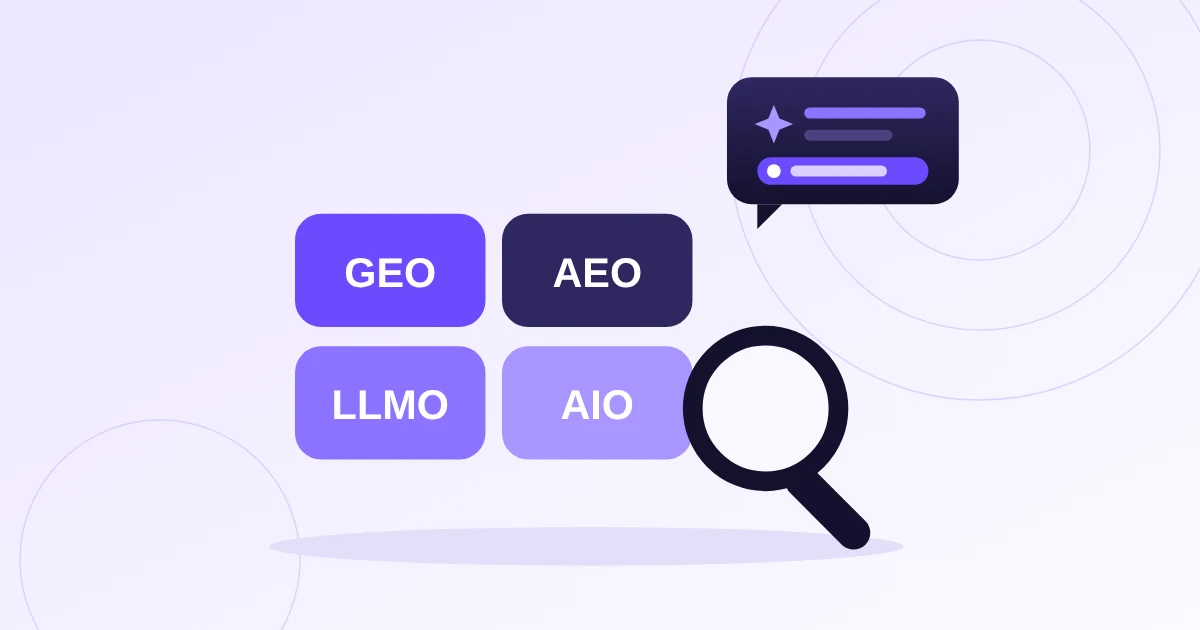
GEO, AEO, LLMO and AIO are different names for closely related work: making your brand easy for AI systems to find, understand and recommend. GEO (Generative Engine Optimization) is the broadest term. AEO focuses on direct answers, and LLMO on large language models specifically.
Why there are so many terms
When search started to change, different groups gave the new work different names. Researchers used “Generative Engine Optimization”. Marketers already using “answer engine optimization” for featured snippets and voice search kept that label. Others coined LLMO, AIO or simply “AI SEO”.
The result is confusing for buyers. Underneath, most of these terms describe the same goal: being included, described accurately and cited when an AI writes an answer.
What each term means
- GEO (Generative Engine Optimization): optimizing for any AI that generates answers, including ChatGPT, Gemini, Claude, Perplexity, Copilot and Google AI Overviews. It covers your website, third-party sources and measurement. See What is GEO.
- AEO (Answer Engine Optimization): an older term focused on direct answers, such as featured snippets, voice assistants and now AI answers. It tends to emphasize question-and-answer content.
- LLMO (Large Language Model Optimization): optimizing specifically for large language models, often with more focus on how models learn about brands from training data and retrieval.
- AIO (AI Optimization) or AI SEO: general umbrella terms. Sometimes AIO is also used to mean Google’s AI Overviews, which adds confusion.
- SEO: still the foundation. AI engines read much of what search engines index. See GEO vs SEO.
Where they overlap
All of these approaches reward the same fundamentals:
- Clear, direct answers to real questions.
- Consistent facts about your business across the web.
- Structured data that labels what you are and what you offer.
- Mentions and reviews on sources AI already trusts.
- Evidence, such as data, examples and specifics, that makes you worth citing.
Where the differences matter
The labels matter less than the scope of work. An “AEO” service that only adds FAQ sections to your site will miss the third-party signals that often decide AI recommendations. An “LLMO” service that focuses on training data may ignore the live web search that ChatGPT, Gemini and Perplexity use for current answers.
When you compare providers, ask what they measure and which engines they test. Our guide on how to choose a GEO agency lists the questions to ask.
Which term should you use?
Use whichever your team understands. We use GEO because it is the broadest and because it describes the outcome: being part of the answer that generative engines write. What matters is that the work covers all four levers of the TUNE method: Trust, Understandability, Network and Evidence.
Key takeaways
- GEO, AEO, LLMO and AIO overlap heavily.
- GEO is the broadest term, covering all AI answer engines.
- The scope of work matters more than the label.
- Ask any provider what they measure and which engines they test.
Frequently asked questions
Is AEO the same as GEO?
Mostly. AEO started with featured snippets and voice search. GEO covers AI-written answers more broadly, including off-site signals and measurement.
Is AI SEO a real discipline or just SEO?
It is SEO plus extra work: consistency, third-party mentions, quotable content and measuring how often AI names you.
Does it matter which term my agency uses?
Not much. Check what they actually do and how they report results.
See what AI says about your business
Get a free AI Mirror: what ChatGPT, Gemini, Claude and Google AI say about you today, and who they name instead.